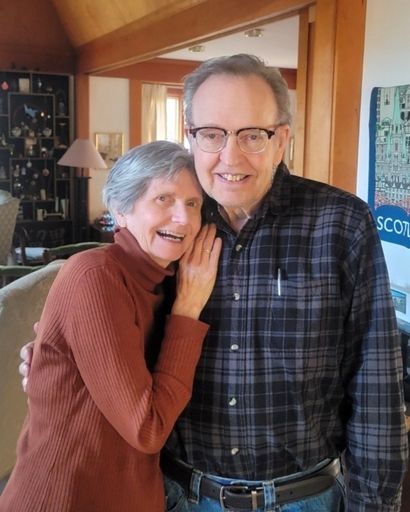
Paul "Douglas" Roller
Paul “Douglas” Roller was a perfect gentleman, but he was never boring. His Roller-Coaster of a life was just like Staunton: always going either uphill or downhill, and always more interesting because of it.
His childhood was an improbable mixture. Born to Paul and Florence (Dundas) Roller in Staunton, Virginia on Saint Nicholas Day in 1939, Doug was a true Virginia gentleman from the start. He had so many wonderful memories of his early childhood. As a young child his Dundas grandparents' house was the first private home in Augusta County to have electricity, and Doug was fascinated by the giant bank of batteries (batteries!) that the house men would take into town to exchange for charged ones. Some memories were gentler than others. He recalled how effortlessly and brilliantly his father (a classically-trained musician, like most of the Rollers) played the violin even when falling-down drunk. He remembered riding in the backseat of his father's Lincoln Zephyr with its bulletproof glass partition– when it was closed, he was in his own private world.
An only child, Doug adored his Roller, Brown, Mitchell, Dundas and other cousins and considered cousin Laura “Tee” Hamilton to be his sister. His childhood went from one extreme to another as he and his beloved mother ended up on their own when he was only nine. After losing his father, he and his mother lived with various relatives for a time before moving to the Virginia School for the Deaf and Blind when she became a houseparent. He was the only child in his friend group who was both hearing and sighted. He gave vivid descriptions of the incredibly long and terrifyingly dark spiral tunnel slides which served as fire escapes for the blind. He learned to skate very fast with his eyes closed. His American Sign Language skills served him well for the rest of his life.
Doug was a cerebral child who read voraciously and emphatically declined the opportunity to attend Augusta Military Academy when he was old enough, being quite sure that there would be plenty of bigger and stronger boys who would have loved to have taught him a lesson since he was a Roller, like the school's founder and commandant.
Those were tough days for a single parent and for a boy without a father. Still, his mother, Florrie, made sure that his manners were impeccable, his diction spotless, and that each home he ever had, whether modest or grand, was filled with art and music. She instilled in him a sense of responsibility to others, including serving as an acolyte at church from an early age. He was was a lifelong member of Emmanuel Episcopal Church, the church his great-grandparents had helped to found in 1893, when they walked out of Trinity, arm-in-arm with Mrs. General Jeb Stuart and other like-minded individuals who proceeded to parade all of two blocks to build their new church across from Stuart Hall. He and the Reverend Ed Covert would later turn this saga into an as-yet-unfinished opera, which we all hope someone will join Ed to finish.
Doug did his part for his family by delivering the Staunton Leader newspaper both morning and afternoon, fourteen times a week from the late 1940s – when his mother had to knot up the strap of his newspaper bag so it wouldn't drag the ground– right up until he and another boy tied for Valedictorian of their high school class despite having had to switch schools multiple times as he and his mother found their footing. On those twice-daily walks and bike rides up and down the hills of Downtown and Newtown and Gospel Hill and the rest of the heart of the city he got to know every detail of the historic buildings along his ever-growing route.
Doug studied architecture at the University of Virginia and was a Jefferson Fellow. He lived on both the Lawn and the Range (like many in his family before and since) before attending Episcopal Theological School in Cambridge, Massachusetts to “test his vocation for the ministry.” Doug always said the church should be quite thankful that he got over that.
After getting seminary out of his system, he headed off to England with his bride Helena “Tidge” Wetzel Roller in tow, studying at the Institute for the Study of Worship and Religious Architecture at the University of Birmingham (England), all set to become the greatest church architect of the twentieth century. He eventually got over that, too– his words again. He and Tidge then took off to drive all over Europe in a Volkswagen Camper van while photographing and sketching every cathedral within hundreds of miles. He returned with a graduate degree in theological architecture, two black cats (who liked the ship only slightly better than the camper van) and the best surprise of his life: baby daughter Helena “Lennie” Dundas Roller.
He and Tidge set out to build the perfect life here in the Shenandoah Valley, where generations of Doug's family had lived since colonial times. They were both very busy with their careers: his in architecture and hers in academia, but they remained focused on community involvement, philanthropy, and “being useful” as they called it. They sang in the Emmanuel Episcopal Church choir and served on the vestry and taught Sunday School. They opened a coffee house named The Needle's Eye, hosted by a rotating cadre of churches, where young people could gather for poetry readings and live music. They immersed themselves in the local theatre scene. They started fostering.
Doug and other passionate young preservationists were horrified to see several blocks of Staunton’s historic Victorian buildings torn down to make way for the square modern brutalist buildings trending in the early sixties. They joined forces to try to save as much of the historic Victorian charm as possible, doing free design work and consultations, writing grants for business owners, and helping people apply for specific historic preservation tax breaks. This became the Historic Staunton Foundation, for whom he was an early president. It was all uphill at first, but HSF played a pivotal role in maintaining the historic charm that makes the town so unique today. They ensured that new city projects like signage and lights and trash cans, benches, and sidewalks, and even the new parking garage had the same authentic vibe. Doug also began his stint of serving over 30 years on the Staunton Board of Building Code Appeals. Many historic district renovators may say a curse word or two when trying to get permission to add a deck or change the roof color, but those neighborhoods where Doug delivered the paper for so many years are still as charming as they have always been.
Meanwhile, Doug designed or renovated or restored many private homes, businesses, and churches in the area. Third Presbyterian Church on Barterbrook was a notable early work, and is located on part of what was once his grandparents’ dairy farm. He also designed the Tree House: his own family's light-filled modern “forever home" on a wooded hillside on the north side of Staunton. He taught his children how to roller skate on the Tree House roof, but did encourage us to keep our eyes open while doing so.
Doug was involved with countless community projects such as the renovation of the Sears House, the Staunton Performing Arts Center, the Dixie/Arcadia Project, the American Frontier Culture Museum, and the Blackfriars Playhouse/ American Shakespeare Center. At the Blackfriars Theatre grand opening, the Rollers took the stage and brought down the house with their version of “Brush Up Your Shakespeare.”
In addition to design work, he wrote witty poems, presentations, and parodies for various events and fundraisers. He was also a long-term member of the Forum Club of Staunton. He and Tidge were brilliant dancers and very active in the local Cotillion. They both led historic walking tours of Staunton and Douglas role-played as Staunton architect TJ Collins in several productions. Together, they did dramatic readings like “The Diary of Adam and Eve” and "The Best Christmas Pageant Ever” and role-played Woodrow Wilson and his eventual wife Ellen Axson, reading their letters aloud at the 50th anniversary of the Woodrow Wilson Birthplace Foundation.
Things were really coming together. Everyone who needed Doug and Tidge seemed to find them somehow. Strays, foster children and foreign students along with elderly relatives stayed for weeks or months or years at a time, and many newcomers joined the family forever.
The Roller Coaster was cresting another hill when they realized that Tidge was pregnant again. Surprise! Twins! Thank goodness for beloved housekeepers Preissy and Blondener, who kept the home running smoothly no matter how many extras were in it. Good thing the Rollers were already good at sharing their space. They read classics aloud at breakfast and watched and discussed Peter Jennings on the news each evening. Doug could beat anyone at Scrabble except, sometimes, Tidge. They traveled extensively including many visits with his Scottish cousin Althea Dundas at the family's ancestral home, Arniston, near Edinburgh.
Life was busy and full: designing countless new builds and renovations, doing plays, play readings, and productions plus 30 years as the president of the board of that “new” community theatre Oak Grove. I don't know how many projects he led or helped with at Emmanuel Episcopal, but they included designing many minor and major additions such as the freestanding alter, adding the elevator, and initializing the preliminary air-conditioning feasibility studies. He won many various awards that he assured me no one would want me to list here. He and Tidge also made it through cancer, both his and hers.
Doug was quite proud of he Roller grandchildren: Lennie and Mike Geipel’s three sons: Clayton (Sarah), Stuart, and Alden; Eric and Janice Roller’s two daughters: Libby and Maisy; and my (Katie Roller Schulz-Ditchen's) and Rob Ditchen's seven: Kit, Rynx, Carrington, and Carter Schulz, and Harrison (Patterson), Reilly, and Elise Ditchen, plus great-grandchildren Emerson and Grayson Ditchen, and then of course scores of foster grandchildren, including our most recent additions, whose names I am not allowed to publish here.
When it was time, Doug designed a retirement cottage right behind the TJ Collins house in Fishersville that he and Tidge had discovered. I (Katie) and Rob and family moved to that house from Atlanta; and Lennie and Mike made the Tree House their own, so that we and our families could be close by to help them. The cottage worked perfectly for Doug and Tidge. We all just lament that it wasn't for longer. We lost Tidge this past Christmas, and now all too soon it is Doug's turn. Dad always shared his observation that the highest incidence of untruths to be heard in a church will be found at funeral services which go to unnecessary lengths, so a memorial service at Emmanuel will be held as soon as the weather cools off, and in any case will be brief.
Which brings us to today. Doug always loved the expression, “Everything will be all right in the end. If it is not all right, then it is not the end.”
Everything must be all right because this is the end.
Doug passed away just before midnight last night: July 12, 2026.
Doug, like Tidge, requested that he continue to be of service in death as he strived to be in life. Therefore he, too, is headed to medical school at the University of Virginia, where the next generation of physicians and other medical professionals can learn from his body.
Douglas Roller’s Celebration of Life will be at Emmanuel Episcopal Church in Staunton, Virginia on Saturday, September 19th, 2026. There will be a reception before and after the service in Memorial Hall starting at 1:00 pm, with the service in the Sanctuary at 2:00 pm.
In lieu of flowers, memorial contributions are encouraged to your favorite local theater or cause, to the Arcadia Project, or to Emmanuel Episcopal Church (maintenance or air conditioning fund).